Do You Need a Flow Builder for Comment-to-DM?
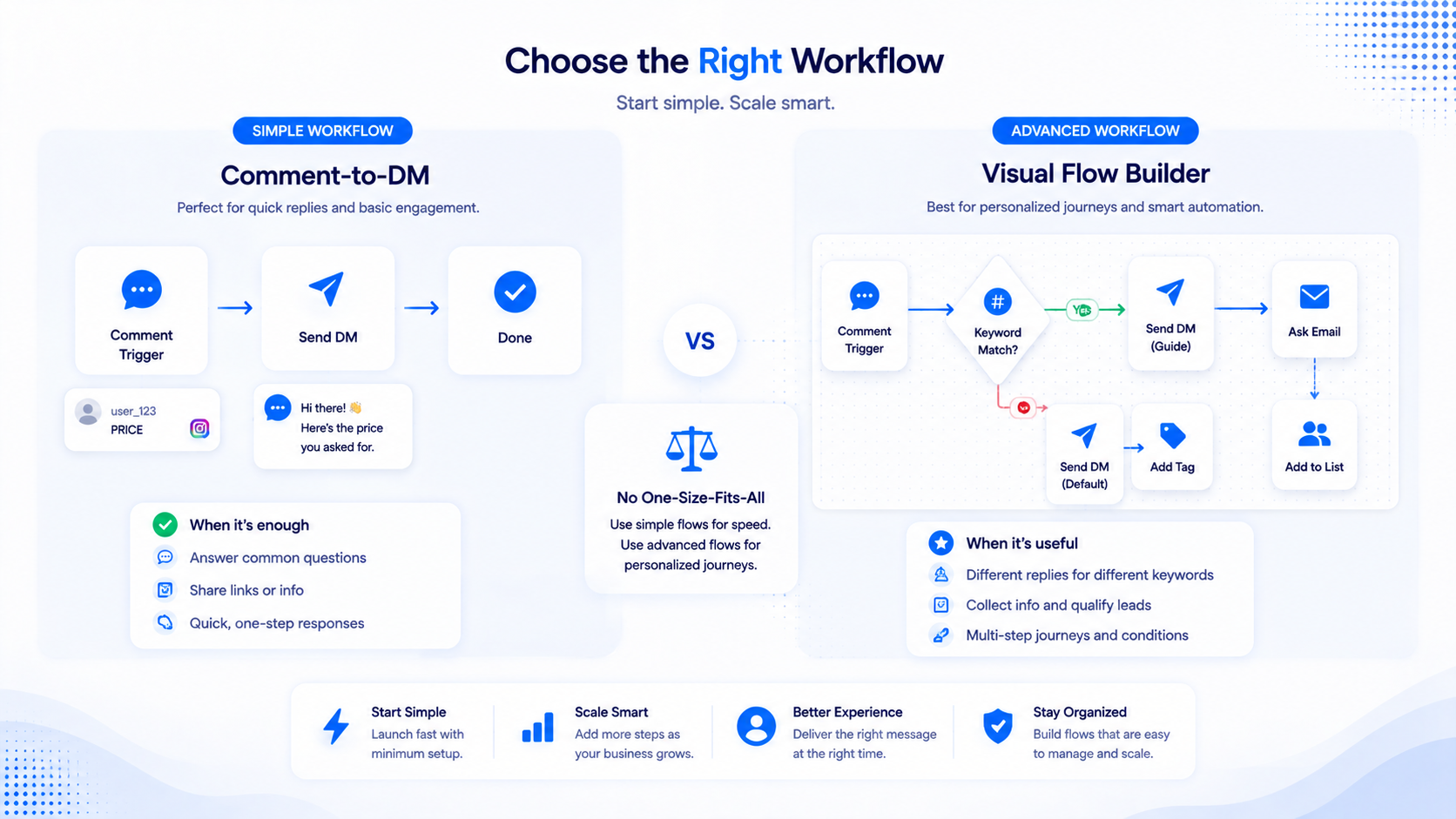
A 20-node canvas looks like sophistication. For “comment LINK, get the URL,” it is mostly delay. ManyChat’s flow builder is genuinely powerful if Instagram is one channel among Messenger, TikTok, and Telegram and you already think in conditions and tags. It is not a prerequisite for comment-to-DM. ManyChat can also do simple AutoDM — claiming otherwise would be false.
CommentLink has a visual flow builder and simple automations. The builder nodes include message, image, buttons, delay, condition, tags, collect (email or phone), follow-gate, AI, HTTP, and handoff. That list exists so you can grow into it. It is not an argument that every Reel needs AI. If you have not shipped a one-keyword send yet, start with Instagram comment-to-DM setup rather than a canvas.
The job that does not need a canvas
Someone comments a keyword. You send one DM with a link or a price. Optionally you leave a one-line public reply. Optionally you show a follow-gate card first. That is a simple automation. Native Instagram Comment to Message covers the DM-on-keyword core without any vendor canvas. CommentLink’s simple automation covers the same core plus matching options, queue, and gate. See native comment-to-DM vs CommentLink.
If that paragraph is your whole programme, you do not need ManyChat’s flow builder, and you do not need CommentLink’s canvas either. Use the smallest surface. Complexity you do not use still has to be maintained when Meta changes an API field.
When a flow builder earns its keep
- You must ask a question and branch (in stock / waitlist / wholesale).
- You collect an email or phone before the PDF.
- You wait, then send a second message if they did not tap.
- You tag the contact for a human team and hand off.
- You call an HTTP endpoint your shop already uses.
- You run Instagram and another channel in one vendor’s model (ManyChat’s usual strength).
Those are conversation designs. Comment-to-DM is only the trigger. Putting twenty nodes before the first URL because a tutorial said “build a bot” makes the commenter wait and burns send quota on scaffolding.
ManyChat versus CommentLink, without a fake winner
ManyChat: broader channels, large template and partner ecosystem, contact-based billing on public plans (see the Free-plan article in this series). Flow builder is a reason people stay. Instagram comment automation is something ManyChat can do, including simple paths. Do not tell a ManyChat customer they cannot send a comment-triggered DM.
CommentLink: Instagram and WhatsApp, official Meta OAuth, no Active Contact meter on our side, simple automations plus a visual builder with the nodes listed above. Weaker as a TikTok/Telegram suite because those channels are not the product. Stronger when the job is Instagram comment-to-DM and a shared WhatsApp inbox.
Pick the vendor whose empty canvas you are willing to maintain. Migrating flows is manual. There is no official ManyChat import into CommentLink.
A sensible CommentLink sequence
- Ship a simple comment-to-DM on one Reel. Test with a second account.
- Add a public reply only if people miss Message Requests.
- Add a follow-gate only if non-followers are the problem.
- Open the flow builder when you need collect-email, a condition, or a handoff — not before.
- Add an AI node only if a human already wrote the policy for what it may say. Do not market the account as an AI chatbot on the strength of one node.
What “visual” does not fix
A canvas will not raise Meta’s hourly Instagram DM cap. It will not turn comments into WhatsApp messages. It will not make cold DMs allowed. It will not replace a Professional account or Meta login. If those are the blockers, builder versus simple is the wrong debate.
Node by node — when to actually add one
- Message: the default. One bubble with the link. Start here.
- Image: a size chart or packaging photo that a URL would bury. Not a carousel of the whole catalogue.
- Buttons: one or two next steps (Shop / Waitlist). Not six.
- Delay: a pause before a reminder, not a fake “typing” trick to look human for 45 seconds.
- Condition: in-stock versus waitlist, or email present versus not. If you cannot name the field, you do not need the node.
- Tags: so the inbox can filter “asked SIZE” versus “asked RESTOCK.” Useless if nobody looks at tags.
- Collect: email or phone before the file. The lead-magnet sequence article covers the copy.
- Follow-gate: I’m following, then is_user_follow_business. Viral giveaways, not size charts.
- AI: a draft inside a policy you wrote. Not an unsupervised closer on a paid Reel.
- HTTP: your shop’s stock endpoint. Not a random webhook tutorial from 2022.
- Handoff: when the person asked for a human or the condition failed. The point of an inbox.
If your canvas is only Trigger → Message, you built a simple automation with extra UI. That is allowed. It is also a signal to go back to the simple editor until a branch appears in real comments.
Anti-patterns copied from chatbot Twitter
Twenty questions before the URL they already requested in the comment. A quiz that restates the caption. An AI node that invents discounts. A delay long enough that they left Message Requests. Three HTTP calls to analytics tools that can fail closed and eat the send. Duplicate follow-gates stacked because someone saw a growth thread.
ManyChat templates for Messenger-era ecommerce will not paste cleanly onto an Instagram comment trigger. Rebuild the first useful DM. Steal structure, not node count.
Simple AutoDM is a product, not a downgrade
Shops that only ever need PRICE / LINK / GUIDE / BOOK should live in simple automations and Instagram DM templates for price, link, guide, and book. The canvas is for the week you need collect-then-PDF or a wholesale branch. ManyChat users who only ever used a one-step Instagram send were not “doing ManyChat wrong.” They were using a large platform for a small job. CommentLink is built so that small job is first-class, while the canvas is there when the job grows.
A useful test: write the conversation on paper as the commenter experiences it. If the paper is “they comment LINK, they get a URL,” you do not need a canvas. If the paper has a fork (“if they say wholesale, collect email, else send retail checkout”), you need a condition and maybe collect. If the paper has a novel, you have too many nodes. Instagram Message Requests punish novels.
Teams stall launches waiting for a “proper bot.” The proper bot for a product Reel is often one published automation, one keyword, one honest DM, a second-account test, and a public line about Message Requests. Add the builder when a real comment thread proves you needed a branch — not when a competitor’s landing page showed a screenshot of spaghetti.
ManyChat remains a good fit when the spaghetti is already your operating system across channels. This article’s question was never “is ManyChat incapable of simple AutoDM?” It can do that. The question is whether you need a flow builder to ship comment-to-DM. Most shops do not, on day one, on either vendor.
FAQ
Does CommentLink have a flow builder?
Yes. Nodes include message, image, buttons, delay, condition, tags, collect, follow-gate, AI, HTTP, and handoff. Simple automations exist beside it.
Does ManyChat require a flow for comment-to-DM?
No. ManyChat can run simpler Instagram automations. The builder is there when the conversation is actually a flow.
Should I rebuild a 40-step ManyChat flow in CommentLink?
Usually no. Rebuild the trigger and the first useful DM. Add branches when they earn their keep. See comment-to-DM setup.
Is the AI node an Instagram GPT product?
No. It is a flow step. Do not sell it as a fully autonomous closer.
Can I start in the simple editor and move to the canvas later?
Yes. That is the intended path. Ship LINK on one Reel this afternoon. Open the builder the week a commenter must choose in-stock versus waitlist or must give an email before the PDF. Migrating a finished 40-node ManyChat bot on day one is how launches slip. CommentLink does not import ManyChat canvases; you would rebuild anyway.
Does a flow bypass Instagram’s hourly DM cap?
No. Every send still goes through the safety queue when it is enabled. A five-node flow that sends five bubbles to one person spends five slots, not one. That is an argument for fewer nodes on a viral Reel, not more.
When is ManyChat’s builder actually the right buy?
When Instagram is one of several channels you already run there, the team already thinks in that canvas, and you accept contact billing. ManyChat can do simple AutoDM too. You would stay for the ecosystem, not because comment-to-DM is impossible without twenty nodes. CommentLink is the smaller surface for Instagram plus WhatsApp on official APIs.
Do I need HTTP and AI to look professional?
No. A short DM with the correct URL looks more professional than a failing webhook. HTTP is for shops that already have an endpoint. AI is for drafts inside a policy. Neither is a ranking factor on Instagram.
Related reading
Start with one keyword, not twenty nodes
Comment-to-DM can be a simple automation. Open the flow builder when the conversation actually branches.
Turn Comments Into DMsRelated articles

Instagram Comment-to-DM Conversion Rate Explained
Pick a stage: comment→DM, DM→click, click→lead. Do not mix them into one “industry average.”
Top 5 Instagram Automation Tools Focused on Comment LINK Workflows
A practical Top 5 for Instagram Comment LINK automation tools — ranking CommentLink, ReplyRush, LinkDM, InstantDM, CreatorFlow for real workflow fit, Meta API safety, and honest channel scope.
How to Attribute Sales with Coupons in Instagram DMs
Unique codes in automated DMs can beat UTMs when checkout is messy — if you rotate codes and accept some leakage.