
Simple Instagram Automation vs Multi-Step Workflows
A keyword and a URL is a complete product for a lot of Reels. A canvas with conditions, delays, tags, collect, follow-gate, and human-handoff earns its keep when the next step depends on an answer. It does not earn its keep because a competitor screenshot looks busy. CommentLink has both: form-style comment automations and a flow canvas. Use the smallest one you will still understand in three months when the intern who built it is gone.
The ManyChat-framed version of this question already exists: do you need a flow builder for comment-to-DM. This article is the operator decision without that competitor in the title. Concrete graphs belong in workflow examples. Qualification-shaped graphs: lead qualification flow. If the job is one file, skip the canvas.
What simple versus multi-step actually means
Simple: trigger matches, send one DM (and maybe a public one-liner), stop. The next human message is unscripted. Multi-step: after they reply, a condition, tag, collect, gate, delay, HTTP, or handoff changes what happens. If nothing they say would change the next node, you do not have a multi-step problem. You have a decorative canvas.
| Signal | Stay simple | Add steps |
|---|---|---|
| Job | One URL they named | Next URL depends on an answer |
| Staff | You will not maintain 30 nodes | Someone owns the graph |
| Risk | Wrong PDF is unlikely | Wrong PDF / wrong calendar is likely |
| Stop | After the send | Handoff, collect, or gate |
How a one-step send differs from a branched flow
- Simple: comment LINK → DM with URL → stop.
- They may still reply. You read that as a human unless you added a later trigger.
- Multi-step: comment PRICE → DM asks size → they reply → condition sends S or M URL.
- If they type something you did not branch, fallback or handoff — you designed that node too.
- Follow-gate, email collect, and human-handoff are steps even when the graph is short.
- Delays that exist to look smart usually just miss Meta’s reply window. Do not delay the payload.
Sample jobs: link drop versus qualify-then-send
Candle shop. Comment SCENT. Simple is correct: one URL to the collection. Branching on “lavender vs sandalwood” only if you will maintain two links.
B2B workshop. Comment SEATS. Multi-step is correct: “team of 1–5 or 6+?” then two different booking pages. A simple send of the 1–5 calendar to a 40-person company wastes everyone’s time.
If you are unsure, ship simple for a week. Add a branch when you see the same reply enough times to be tired of handling it by hand.
A florist who gets “same-day?” on every PRICE comment has earned a two-branch flow: YES → today’s cutoff URL; NO → the ordinary catalogue. That is still four nodes, not a CRM. A florist who gets a different question every time should stay simple and hand off the weird ones. Multi-step is for repeats you can name.
Implementing the smallest graph that works
- Write the job in one sentence.
- If the sentence has no “if they say,” use a simple comment automation.
- If it has one if, add one condition. Stop there.
- Put collect email only if you will email them from a tool you actually use — CommentLink is not HubSpot.
- Add human-handoff for refunds and custom quotes even on simple rules (a stop can be a node on a short flow).
- Document the graph in a note so the next operator can delete nodes, not fear them. See DM automation for the wider surface.
Canvas-for-show mistakes
- Copying a 40-node competitor template. Instead: copy the job.
- Asking five questions before the file. Instead: file first; questions after they reply if needed.
- Delaying the link “for a natural feel.” Instead: first bubble carries the payload (one private reply per comment).
- AI reply on every branch because you can. Instead: AI is a node, not a personality; hand off when it guesses.
- HTTP to a CRM you do not have. Instead: skip; no native Salesforce sync.
- Multi-step on a keyword you change weekly. Instead: simple, or you will ship a stale branch.
Operator habits that keep flows maintainable
- Name nodes after the job, not “Untitled 4.”
- One live graph per offer.
- Review fallbacks monthly.
- Delete branches you never see in the inbox.
Copyable choose-your-shape worksheet
Job: ________. Does their reply change the URL? No → simple send. Yes → one condition. Do you need a follow before the prize? Yes → gate node. Do you need a person? Yes → handoff. Anything else → you are decorating.
Ship the left column first. Add right-column nodes only after real replies demand them.
Form-style comment automations versus the canvas
CommentLink still lets you attach a keyword, a DM, and an optional public reply without opening a graph. That is the right default for LINK, MENU, and TOUR. Open the canvas when you need a condition on their next message, a follow-gate node, collect, HTTP, or human-handoff as a designed stop. If you open the canvas and only put a send node in it, you built simple with extra clicks.
Teams copy ManyChat screenshots because they look like “real automation.” Instagram private replies do not become smarter because you added a delay. The payload still has to live in the first bubble. Extra nodes that do not change the URL are maintenance you will skip during a launch week.
Why delay nodes usually fail this job
People delay the link “so it feels human.” Meta’s private-reply model is one message per comment until they answer. If you wait to send the URL, you either sent a useless first bubble or you sent nothing useful in the window you had. Feeling human is copy and a real name on the handoff — not a 10-minute wait.
Delays after they reply can make sense (wait for a human during hours). Delays before the prize do not. If you need overnight coverage, say the hours in the first DM instead of queuing a fake typing pause.
When even a simple rule should hand off
Simple is not “the bot handles anger.” Refund, legal, medical, and custom price still stop. Multi-step is not “the bot handles anger with more nodes.” Extra branches on a complaint usually make it worse.
If nobody will maintain the canvas, simple plus a human inbox is the professional choice.
A gym PRICE comment that earned one branch
Boutique studio, comment PRICE. For two weeks the simple DM sent the intro-week URL. Inbox filled with “this is for a company offsite, 18 people.” That repeat is the branch. New first DM: “Intro week: [URL]. Booking for 1 person or a team? Reply 1 or TEAM.” 1 → checkout. TEAM → corporate one-pager. Fallback → “Reply 1 or TEAM.” Still four nodes. Not a CRM.
If the next month’s replies are all different (injury, gift card, “my cousin already comes”), stay simple and hand off the weird ones. Multi-step is for repeats you can name, not for every sentence that surprised you once.
What the canvas cannot replace
A delay node is not a personality. Meta’s private reply is one message per comment until they answer. Waiting ten minutes to “feel human” either wastes the bubble or sends nothing useful. HTTP is not HubSpot or Salesforce — there is no native CRM. AI reply is a node, not Meta Business Agent, and it should not invent prices. Live comments, Trial Reels modes, Broadcast Channel posting, and Click-to-DM ads are not canvas triggers.
If you open the canvas and only drop a send node in it, you built simple with extra clicks. Form-style comment automations still exist for LINK, MENU, and TOUR. Use them.
Copyable “one if” test before you grow the graph
Write: “If they say ____, the URL changes to ____. Otherwise the same URL.” If you cannot fill both blanks, do not add a condition. If you can, add that one condition, name the nodes (INTRO / TEAM), and ship. Watch ten real replies. Delete the branch if you never see TEAM.
Put refund, legal, and custom quote on a handoff even when the graph is this small. Extra branches on a complaint are not multi-step. They are a second pitch.
FAQ
When do I need multi-step Instagram flows?
When the next step depends on an answer, a tag, or a human. Not because the canvas looks impressive.
Is a simple keyword DM a real automation?
Yes. It is the default shop pattern. Multi-step is extra machinery.
Does CommentLink have a flow canvas?
Yes: conditions, delays, tags, collect, follow-gate, AI reply, HTTP, human-handoff. Use what the job needs.
Should I start in the canvas?
Start simple unless you already know the branch. You can grow the graph.
Is this the ManyChat comparison?
No. That article exists separately. This one is shape: one send versus a graph.
What is a good first multi-step?
One qualify question, then two URLs. Not a 30-node onboarding.
When did a simple PRICE rule earn a branch?
When the same reply showed up enough times that staff were tired of handling it by hand — for example 1 versus TEAM. Not after one weird comment.
Can a delay make the DM feel more human?
Not before the prize. The first bubble has to carry the payload. Hours in the copy beat a fake pause.
Is HTTP a substitute for HubSpot?
No. There is no native Salesforce or HubSpot product. Skip HTTP unless you own the endpoint and will maintain it.
Related reading
See Instagram DM automation
Comments, Stories, keywords, follow-gates, lead capture and a shared inbox — official Meta APIs.
See DM automationRelated articles
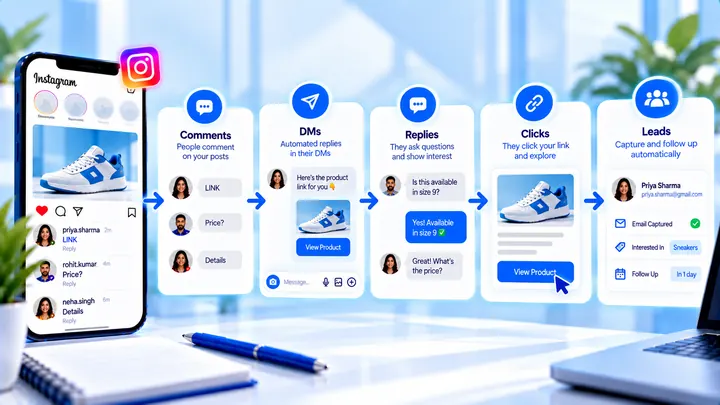
Instagram Comment-to-DM Conversion Rate Explained
Pick a stage: comment→DM, DM→click, click→lead. Do not mix them into one “industry average.”

Instagram DM Open Rates: What’s Measurable (and What Isn’t)
Instagram does not give automation tools a standard DM open rate. Track replies, clicks, and attributed leads instead of vanity opens.
Grow a Newsletter with Instagram Comment-to-DM
Comment JOIN or NEWSLETTER, collect the email in the DM, send the subscribe confirmation — without baiting a sales pitch.